


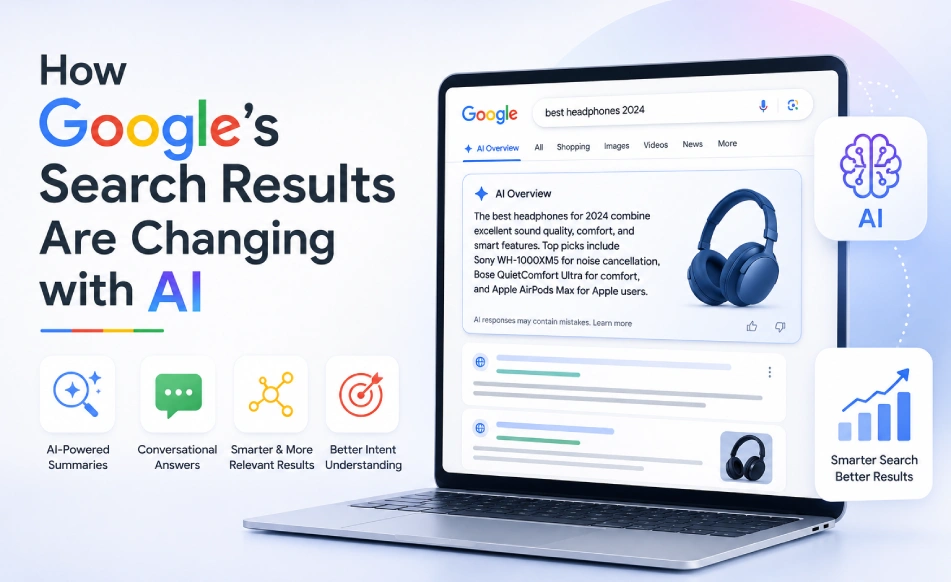
For years, searching on Google followed a familiar pattern. A user entered a few keywords, Google displayed a list of relevant websites, and the user clicked through different results to find the information they needed.
That experience is changing.
Artificial Intelligence is transforming Google Search from a platform focused primarily on finding links into a more interactive experience that can help users understand information, compare options, ask follow-up questions and explore complex topics in greater depth. With AI Overviews, AI Mode and increasingly conversational search experiences, users are no longer limited to typing short keyword phrases and choosing from a traditional list of results.
Instead, they can ask Google questions in a more natural way.
For businesses, marketers and website owners, this change is significant. The question is no longer simply, “How can my website rank on Google?” Businesses must increasingly consider how their content can remain visible when Google helps users find and understand information through AI-powered search experiences.
From Keywords to Conversations
Traditional search often encouraged users to keep queries short.
A person looking for a digital marketing agency might previously search for something like “SEO company Pune” or “best digital marketing agency.” They would then review several websites, compare services and continue searching for additional information.
AI is making it easier to search differently.
A user can now ask a more detailed question such as:
“Which digital marketing strategy would be suitable for a small business in Pune with a limited budget that wants more local leads?”
This type of search contains much more context. It includes the business type, location, budget and desired outcome.
Google’s AI-powered search experiences are designed to handle longer and more complex questions. Google reported in May 2026 that the average AI Mode query is approximately three times the length of a traditional Search query, while people are increasingly using Search for planning, brainstorming and decision-making.
This means businesses need to think beyond individual keywords. Understanding the complete question, customer problem and search intent behind a query is becoming increasingly important.
AI Overviews Are Changing What Users See First
One of the biggest changes to Google Search is the growing role of AI Overviews.
AI Overviews can provide an AI-generated summary directly within the search results when Google’s systems determine that a generative response would be helpful. The response can bring together information from multiple sources and provide links for users who want to explore the topic further. Google also allows users to continue exploring through follow-up questions.
For users, this can make research faster.
Instead of opening five different websites to understand a topic, a user may first receive a summarized explanation and then decide which sources they want to explore further.
This changes the competitive landscape for businesses.
Previously, the goal may have been to secure a prominent position among traditional organic search results. Now, a business may need to compete for attention across multiple areas of the Search experience, including AI-generated responses and the links presented within them.
However, this does not mean that websites are no longer important. Google continues to emphasize that its AI search experiences connect users with information from across the web and that links remain part of the experience. In 2026, Google also introduced additional features designed to surface relevant websites, original content and trusted sources within AI-powered Search.
The opportunity is changing from simply ranking as a link to becoming a useful and credible source that can support different Search experiences.
AI Mode Is Making Search More Interactive
AI Mode represents an even more conversational approach to Search.
Instead of receiving one response and starting a completely new search, users can ask follow-up questions and continue exploring a topic. The search experience can develop into an ongoing conversation.
For example, someone researching a new website could start by asking:
“What should a small business website include?”
They may then follow up with:
“How much should it cost?”
After that:
“What features are important for an e-commerce business?”
And finally:
“How can I choose the right website development company?”
This is very different from the traditional process of entering four separate keyword searches.
Google has continued expanding AI Mode with improved conversational capabilities and multimodal inputs. Its 2026 updates also allow users to move from an AI Overview into a more detailed conversation, keeping the context of their search as they explore further.
For businesses, this means content needs to do more than answer one narrow keyword query. A strong website should help answer the broader questions a potential customer may ask throughout their research journey.
Search Is Becoming More Multimodal
Another major change is that people are no longer searching only with text.
Users can increasingly combine text, images, voice and other forms of input to find information. Google has reported that more than one in six AI Mode searches in the U.S. use voice or images, with image searches showing significant growth. Google has also expanded Search Live, which allows users to interact with Search using voice and a camera in supported locations.
Imagine a user taking a photograph of a product and asking what it is, comparing two visual designs or showing Google a real-world object through their phone camera while asking for help.
Search is becoming more flexible because users do not always know the right words to describe what they are looking for.
For businesses, this creates a greater need for high-quality visual content. Original images, properly presented products, useful videos, demonstrations and accurate supporting information can all become part of a broader digital visibility strategy.
A business website in the future cannot rely only on written keywords. Its complete collection of content—including text, images and video—can contribute to how discoverable and useful the brand is online.
Users Are Asking More Complex Questions
AI is also changing the types of questions people expect Google to answer.
Traditional search was often used to find a specific webpage or quick answer. AI-powered Search can assist with more complex tasks that may involve comparisons, planning, brainstorming and multiple constraints.
For example, instead of searching separately for:
“SEO cost”
“SEO company”
“SEO results time”
and
“SEO strategy for small business”
a user may ask one detailed question that combines all of these requirements.
This means businesses need to create content that demonstrates a deeper understanding of customer needs.
A generic page containing a few hundred words and repeatedly mentioning a target keyword may not provide enough value for someone researching a complex decision.
Businesses should consider creating content that answers questions such as:
What problems does the service solve? Who is it suitable for? What should customers expect? What factors affect the cost? How does the process work? What mistakes should customers avoid? How long can results take?
The more effectively a business answers genuine customer questions, the stronger its foundation for visibility becomes.
The Traditional Search Result Is Not Disappearing
It is important not to assume that AI means traditional SEO has become irrelevant.
Google has specifically stated that SEO best practices remain relevant and foundational for success in its generative AI features. In May 2026, Google published additional guidance for website owners focused on optimizing for generative AI experiences, emphasizing valuable, unique and non-commodity content while continuing to reinforce established SEO fundamentals.
Traditional search results, websites and web content remain essential.
AI needs access to useful information, and users still need to visit websites to learn more, evaluate businesses, make purchases and complete important actions.
The goal for businesses should therefore not be to abandon traditional SEO and chase a completely separate “AI SEO” strategy.
Instead, they should strengthen the fundamentals:
Create genuinely useful content. Make the website easy to crawl and understand. Clearly explain products and services. Build trust. Use relevant images and videos. Maintain accurate information. Provide a strong user experience.
These fundamentals support visibility across traditional and evolving Search experiences.
Original Content Is Becoming Even More Important
As AI makes it easier for businesses to generate large volumes of content, simply publishing more content is becoming less valuable as a strategy.
If hundreds of websites publish nearly identical articles about the same topic, there is little reason for users to choose one over another.
Businesses need to provide something distinctive.
This could include real case studies, first-hand experience, original research, customer insights, expert opinions, unique examples or practical information based on actual work.
For example, instead of writing another generic article titled “What Is SEO?”, a digital agency could publish:
“5 SEO Mistakes We Commonly Find When Auditing Small Business Websites”
This type of content can provide a more specific and original perspective.
Google has also been adding features to AI Search intended to help users discover original content and trusted sources, including direct links, article suggestions and ways to highlight preferred or highly cited sources.
For businesses, the lesson is clear: being different and genuinely useful matters more than simply producing a high volume of similar content.
Search Visibility Is Becoming About More Than Rankings
For many years, SEO reporting focused heavily on keyword rankings.
Businesses wanted to know whether they were number one, number three or on the second page of Google.
Rankings will continue to matter, but AI-powered Search makes digital visibility more complex.
A business may appear through a traditional result, an AI-generated response, an image result, a video, a local listing or another Search feature.
This means SEO measurement should also become more business-focused.
Instead of looking only at rankings, businesses should consider:
How often is our brand appearing in relevant searches? Which pages are attracting qualified visitors? Which topics are generating visibility? Are visitors exploring our website? Are they making enquiries? Which content is helping customers discover us?
The final goal is not simply to receive an impression.
The goal is to connect with the right audience at the right stage of their decision-making process.
Local Businesses Must Focus on Relevance and Trust
AI-powered search could also change how users discover local businesses.
Rather than searching only for “SEO company near me,” a customer may describe their specific requirements in detail and ask Google for options that fit those needs.
For example:
“I need an SEO company in Pune that can help a manufacturing business improve local search visibility.”
The search is more specific and more intent-driven.
For businesses, accurate local information becomes essential. Service pages should clearly explain what the company offers, which locations it serves and what types of customers it works with. Business information should remain consistent and up to date, while the website should provide useful evidence of experience and expertise.
Google’s 2026 guidance for website owners also highlights the value of providing useful local content alongside unique content and other SEO fundamentals.
Simply adding a city name repeatedly to a webpage is not enough. Businesses should provide meaningful information that demonstrates genuine relevance to the location and audience they want to serve.
AI Is Changing the Customer Journey
Perhaps the biggest change is that Google Search is moving closer to becoming part of the entire customer research journey.
Previously, users often performed separate searches at different stages. They searched for information, then searched for options, then searched for reviews and finally searched for a business.
AI can make these stages more connected.
A user can begin with a broad question, ask follow-up questions, compare alternatives and continue exploring within the same experience.
This means businesses should think carefully about the content they provide across the customer journey.
Someone at the beginning may need educational information. Someone comparing solutions may need detailed guides and examples. Someone close to making a decision may need service information, case studies, testimonials and a clear reason to contact the company.
A strong SEO strategy should support all of these stages.
What Should Businesses Do Now?
Businesses do not need to panic every time Google introduces a new AI feature.
The most effective response is to strengthen the quality of the website.
Create content based on real customer questions rather than publishing articles simply to target keywords. Develop detailed service pages that explain what you offer and who you help. Add original examples, case studies and insights that competitors cannot easily copy.
Make sure the website is technically sound and easy to navigate. Connect related content through logical internal links. Keep important information accurate and up to date. Invest in useful images and videos where they add value.
Most importantly, think about the complete customer experience.
If someone discovers your business through Google, can they quickly understand what you do? Can they find answers to their questions? Can they see why they should trust you? Is there a clear next step?
These questions will remain important regardless of how Search continues to evolve.
Final Thoughts
Google’s Search results are changing from a primarily keyword-and-link-based experience into a more intelligent, conversational and interactive system.
AI Overviews can summarize information and provide pathways to explore further. AI Mode allows users to ask longer questions, continue conversations and research complex topics. Voice, images and camera-based interactions are creating new ways to search. At the same time, Google continues to connect these AI experiences with information and content from across the web.
For businesses, this is not the end of SEO. It is an evolution of SEO.
The businesses most likely to remain visible will not focus only on chasing rankings or producing large quantities of AI-generated content. They will build useful websites, publish original and trustworthy information, understand customer intent and create content that genuinely helps people make better decisions.
At Websoft Techno, this shift creates an opportunity to approach SEO as part of a larger digital strategy. By combining strong website development, technical SEO, valuable content, local optimization and a clear understanding of how customers search, businesses can prepare for both the Google Search of today and the AI-powered Search experiences that continue to develop.
The future of search is not simply about being found.
It is about being useful enough to be discovered, trusted enough to be considered and valuable enough to be chosen.